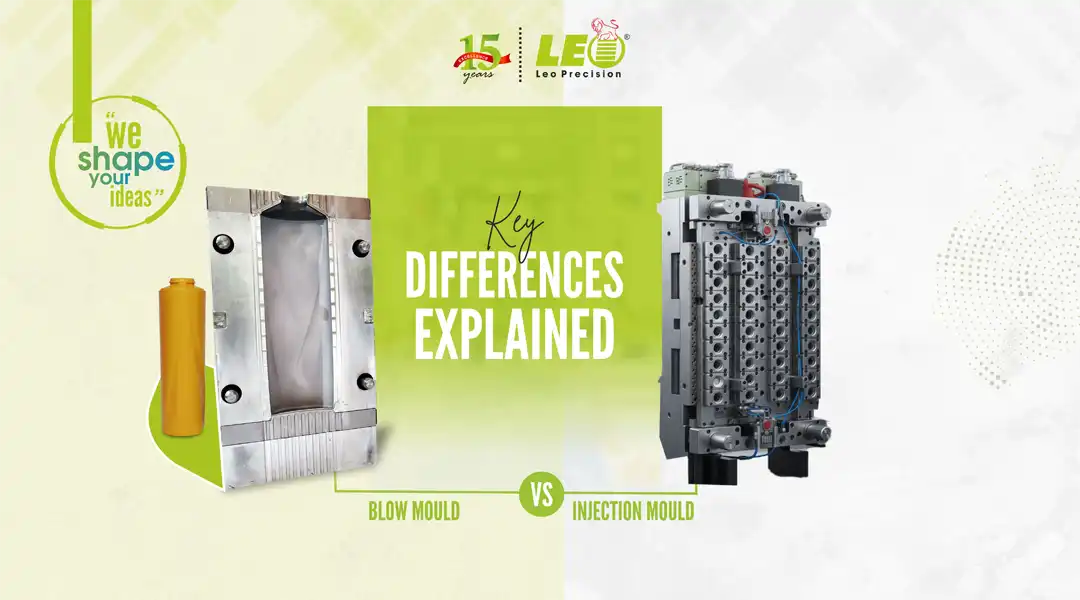
In plastic manufacturing, selecting the right moulding process is critical to product
quality, production efficiency, and cost optimisation. Two of the most commonly used
processes are Injection Moulding and Blow Moulding. While both are fundamental to the
plastics industry, they serve very different purposes.
This article breaks down the key differences between injection moulds and blow moulds,
helping manufacturers choose the right solution for their application.
What Is Injection Moulding?
Injection moulding is a manufacturing process where molten plastic is injected into a
closed mould cavity, cooled, and ejected as a solid part.
Common Applications
- PET preforms
- Caps & closures
- Medical disposables (syringes, blood collection tubes)
- Automotive and industrial components
Key Characteristics
- High dimensional accuracy
- High dimensional accuracy
- Tight tolerances
- High repeatability for mass production
What Is Blow Moulding?
Blow moulding is a process used to create hollow plastic products by inflating heated
plastic inside a mould cavity.
Common Applications
- Bottles and containers
- Jerry cans
- Pharmaceutical packaging
- Cosmetic and FMCG bottles
Key Characteristics
- Ideal for hollow parts
- Uniform wall thickness
- High output for containers
- Lower tooling complexity compared to injection moulds
Injection Mould vs Blow Mould: Comparison Table
| Parameter |
Injection Mould |
Blow Mould |
| Product Type |
Solid or semi-solid parts |
Hollow containers |
| Material Flow |
Plastic injected under high pressure |
Plastic expanded using air |
| Tooling Complexity |
High |
Medium |
| Dimensional Accuracy |
Very high |
Moderate |
| Typical Products |
Preforms, caps, medical parts |
Bottles, containers |
| Surface Finish |
Excellent |
Good |
| Cycle Time |
Moderate |
Faster for large volumes |
Which Process Should You Choose?
-
Choose Injection Moulding if your product demands precision, strength, and tight
tolerances.
-
Choose Blow Moulding if your product is hollow and volume-driven.
Many industries use both processes together—for example, PET bottles use
injection-moulded preforms followed by blow moulding.
Conclusion
Understanding the distinction between injection moulds and blow moulds enables
manufacturers to make informed production decisions. Precision, application, and output
requirements should guide the choice not just cost.